
On Saturday, funeral ceremonies were held for the victims of the Volhynia massacre exhumed in Puźniki in western Ukraine. On this occasion, President Karol Nawrocki addressed a letter to the participants. “I rejoice at the ray of hope that has shone over this blood-soaked land – hope for truth, justice, and reconciliation between brotherly nations,” reads one excerpt.
Puźniki was a former village in today’s Ternopil region, where on the night of February 12-13, 1945, Ukrainian nationalists murdered – according to various sources – between 50 and 120 Poles. The main perpetrator of this crime was Petro Chamczuk, who commanded a The Ukrainian Insurgent Army (UPA) unit Siry Wowky (Grey Wolves). At 3 a.m. on February 13, Chamczuk’s battalion-sized formation made up of two companies attacked the inhabitants of Puźniki. Only a dozen or so people capable of defending themselves were present.
The massacre in Puźniki was one of the last operations of the Grey Wolves. Chamczuk and his subordinates were never punished.
The result of the exhumations
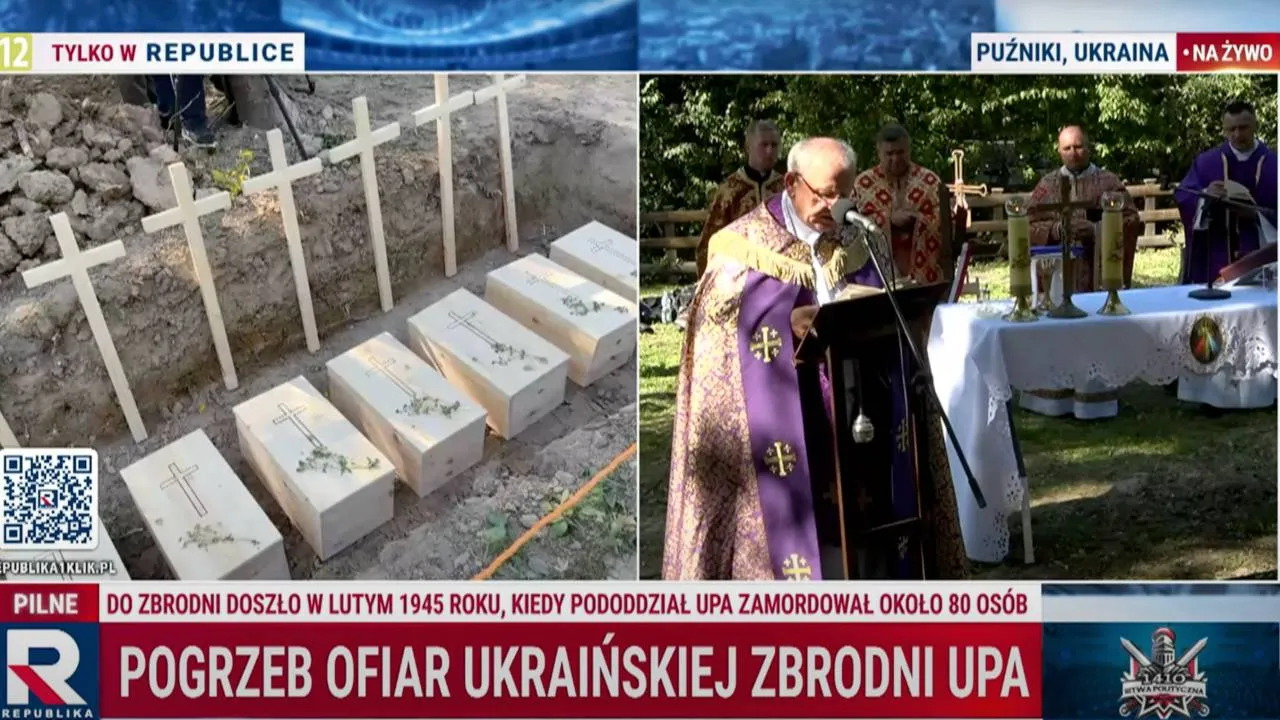
Exhumations in Puźniki took place from April 23 to May 10. The remains of at least 42 people were found. These were the first works of this kind since November 2024, when the Ukrainian side lifted the ban on searches and exhumations of Polish victims of wars and conflicts on Ukrainian territory.
Today, the funeral ceremonies of these victims were held. On this occasion, the President of the Republic of Poland, Karol Nawrocki, addressed a letter to the participants. The letter was read in Puźniki by Head of the Presidential Office of International Policy (KPRP), Marcin Przydacz. Below is the President’s letter:
Honored Survivors, Ladies and Gentlemen,
“If I forget about them, You, God in heaven, forget about me” – these words from Forefathers’ Eve (Dziady) by Adam Mickiewicz, though they concern other, earlier Polish martyrs in the East, today still resonate in our hearts and minds. They are like an epitaph, like a mournful song with which we bid farewell to the murdered compatriots from the village of Puźniki in the former Tarnopol Voivodeship.
Everyone who has even heard of the genocide in Volhynia, Podolia, and Galicia cannot remain indifferent to this history. No righteous, honest person – and certainly no one who calls themselves Polish – can consider this tragedy an insignificant, distant episode of history, unnecessarily occupying our attention more than 80 years later. The destructive dimension of those crimes extends into the present, for the tears of survivors, the relatives, and descendants of the victims still flow. They long to complete their mourning, to bury their dead with dignity, and to pray at their graves. We Poles are by no means seeking revenge, but at the same time, we do not want and cannot forget the tens of thousands of our compatriots – men, women, and children – killed only because they spoke and prayed in Polish. Nor is it in our power to forgive on their behalf – or to forget that Ukrainian chauvinists inflicted upon them torture and death so bestial, so beyond human imagination. No one deserves such a cruel death, not even the greatest evildoer. How much less did the Polish inhabitants of this land deserve it – people who never organized themselves to attack their Ukrainian neighbors, friends, or relatives. No political rationale, no geopolitical calculation, no ideology or ancient grievance can justify burning children alive, torturing pregnant women before their husbands’ eyes, mutilating people with farming tools so they would die slowly in terrible pain. Even today, no – I repeat: no – arguments or interests justify a situation in which the victims’ remains still await a dignified burial, and the circumstances of their death await proper documentation and commemoration.
Ladies and Gentlemen,
Praying with you today, with a heavy heart I think of the last moments of the Poles – the inhabitants of Puźniki, burned and slaughtered on the night of February 12-13, 1945, by members of the Ukrainian Insurgent Army (UPA). At the same time, I rejoice at the ray of hope that has shone over this blood-soaked land – hope for truth, justice, and reconciliation between brotherly nations. I warmly thank all those involved on both the Polish and Ukrainian sides. Thanks to their work, we can today bid farewell and mourn our tragically killed compatriots with dignity, and at least to some degree soothe the pain of their relatives. For us Poles, today’s ceremony has the rank of an important symbol. A symbol that will begin a lasting process – a process of sincere forgiveness and reconciliation. That is why I express hope and expectation that it will soon be followed by other funerals of victims – in all the localities where genocidal crimes against Poles were committed. We cannot neglect to honor any of the slain. At the same time, concern for commemorating their memory compels us not to remain silent about a sad fact: not far from here, in the town of Czortków, stands a monument not only to the leader of the OUN-B, but for 11 years also a monument to the commander of the criminal company that took part in the extermination of the inhabitants of Puźniki. We consider this unacceptable, both for the relatives of the murdered and for the entire Polish Nation.
I deeply believe it need not be this way. I am convinced that the collective wisdom of Poles and Ukrainians, as well as the scholarly and political elites representing our nations, will enable a sincere, constructive dialogue about the impact of modern history on our present and future relations. Poland supports Ukraine’s aspirations to belong to European structures and to the zone of stability, development, and solidarity. But it must be emphasized that this is also a community of values, ethical attitudes, and civilizational standards. It was in large part shaped by Christian thought, which commands forgiveness of every sin, however grave – but only under the condition of admitting guilt, sorrow for the evil committed, and at least symbolic atonement. It is obvious that glorifying criminals – people tainted by collaboration with Nazi Germany and consumed by ethnic hatred – has nothing in common with this vision. On the contrary, it casts doubt on the sincerity of the will for reconciliation and becomes a weapon in the cynical propaganda war for minds that Russia – the ruthless enemy of the freedom and sovereignty of Central and Eastern European nations – has long been waging. That is why our reconciliation is all the more crucial now – when Ukraine must fight for freedom and sovereignty against the Russian occupier. I am convinced that this process, though difficult, will only strengthen cooperation between our nations in this historic moment.
Ladies and Gentlemen,
In three years, we will mark the 370th anniversary of one of the most important events in the history of Polish-Ukrainian relations – the signing of the Union of Hadiach. A union that, centuries ago, guaranteed Ukraine’s lasting belonging to European civilization. I sincerely hope that by then the process of authentic Polish-Ukrainian reconciliation will have truly begun, and that the still-bleeding wound of the genocide committed in Volhynia, Podolia, and Galicia will begin to heal. May truth and justice become the cornerstone of our friendship, and may opening a new chapter in our shared history bring our two nations broad perspectives of living in peace, prosperity, and mutual respect.
Eternal memory and eternal peace to the victims of the crime in Puźniki!
Saint Michael the Archangel, vanquisher of the spirit of lies and division, patron of Ukraine – support our efforts for just reconciliation!
With respect,
Karol Nawrocki
President of the Republic of Poland